Visualizzazione post con etichetta equipment. Mostra tutti i post

Recycling water "Own Means"


The place where my vetiver plants grow  is virtually surrounded 
by farms and farmers that, despite any legislation on  
the disposal of nitrates, dispose of the wastewater simply discharging it in 
holes in the ground, or better in ditches. 
Given that here the irrigation water costs 150€ for 45 days 
by the single hydrant (as a result of an effective 
privatization action conducted in recent years 
in a bipartisan fashion by any government and 
by each regional authority), I have decided to proceed 
as usual with "Own Means" to dispose of some pollution 
that ends up at sea (very close to the land in question) and save 
some money which, these days, for sure, will find better use elsewere.
 
The ditch bottom  retains a good 50 cm of water 
(for a flaw of execution) until at least July, 
I therefore devised a two stages system, able to filter the suspended solids. 
The first stage consists of a gravel filter contained within a 
concrete pipe that sat abandoned for years in the nearby field;
a submerged pump draws the water through the gravel which, this way is kept free of algae and 
mucilages present in industrial quantities, 
thus denouncing the strong presence of nitrates and phosphates. 
The second stage is built with a modified pump pressure aid  with 
two check valves, a couple of fittings, and filled with quartzite to operate 
a more accurate sand filtration of water. 
The chemical quality of water of course does not change, 
the plants take advantage of the nourishment excess 
and the excess of such irrigation is released in the watertable after 
a vertical filtering operated by the plant itself.
A double goal is so achieved: intercept pollution and save money.
Not just a pretty face....

Vetiver and mass production: Update


Today I received the periodic update about the in-vitro propagation protocol of vetiver: 
here's the news: there were no major problems with bacterial or virus contaminations 
and only in one case 
a re-sterilization was necessary, the buds extracted started to grow and 
perhaps a month  the  proliferation phase will begin, followed by the greenhouse hardening of the first plants. 
Soon a first batch of plantlets Will be produced  in order to perform a field pilot test, 
maybe at the end of spring. 
Perhaps then, at the end of summer we will have obtained some genuine data on this promising chapter.
Many thanks to Romano and all the people involved.

Vetiver and mass production


In order to shoot dead all the obstacles that can arise and the difficulties to the spreading of the Vetiver technology, and in order to make more accessible to everyone and more competitive the hedgerow system, from today, vetiver Sardegna has begun a new path of studies: the in vitro production.
The final aim is to reduce as much as possible the cost of the single plant and uniform all propagation material to a standard that makes easy the use of mechanized planting.
With this method we will obtain to reduce the main economic obstacle to the spreading of the vetiver system: the cost of labour and propagation material.
Next season will be used to asses the costs and devise a method to mechanize the planting of hedgerows, plus a comparison with other methods of environmental protection.
Yesterday, 5th of November I have signed a preliminary agreement with one of the biggest nursery production sites; their work is mainly in the fruit tree production, I have found some very good allies, in love with their work and their mission, that will make possible this great project to come true.
Next spring, after a preliminary  period of  study of the material, we will asses together how beneficial this method will be to our work.

Vetiver biomass: second milling test


This second test was conducted with a forage mill:
as obvious, the machine is too small to chop large
quantities of biomass, but was the only one of
that kind available at the time; there are much
bigger ones. What really counts is that the chopping
is performed on the horizontal axis as compared
to the insertion direction of the biomass.

This fact guarantees a much stronger coherence
if compared to the previous test.

The result was much more satisfactory than the
previous one; next year I'll chop a large quantity 
of leaves and stems with a much larger mill. also 
the timing of the operation will be an interesting 
data to account for.


Vetiver biomass: milling test


First milling test performed in order to obtain 
heater grade chopped biomass:
Just about 30 Kg of biomass have been transformed.
The objective is to find a tool (power or engine) that chops 
leaves and stems down to the correct size for burning in an 
automatic biomass heater.
The point is, besides the size, that the product has to be 
coherent.
No further operations will have to be needed afterwards to 
preserve economicity.

The result of this first test is not completely satisfactory 
because the product presents different sizes. To achieve 
a better result, sieving is necessary in order to discard 
oversize material.

The problem starts with the machine's work: the chopping 
is done on the same axis of insertion of the biomass: this 
makes also the machine prone to choking. The final product 
is part pulverized, part oversize.

Let's move over.


4WD Ferrari


A new giant leap (veeeery hard worked) is just been made:
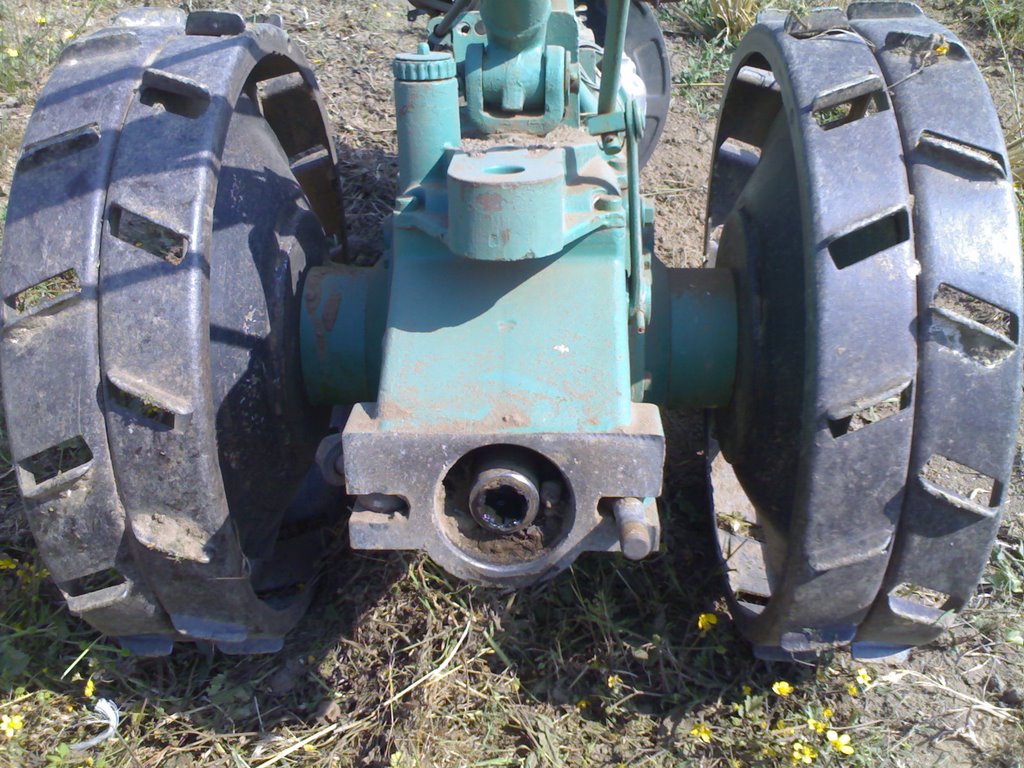
The Ferrari is now supported by the Toyota and, finally I can plant vetiver hedgerows almost anywere with little effort.
The two machinery together make just about my age but with a little restoration I'm sure that I can do many things for a long time.
Now I'll paint it RED! Ferrari red!
Champagne!!!!!!!!!

Giant leap


At the end of winter, with some spare money obtained with small jobs around, I buy myself a Ferrari: a rotative hoe, 12 horse power with a 80 cm wide hoe section and furrow excavator; four speed plus reverse. Cool!


I get in association with another mad one, the good Marta.
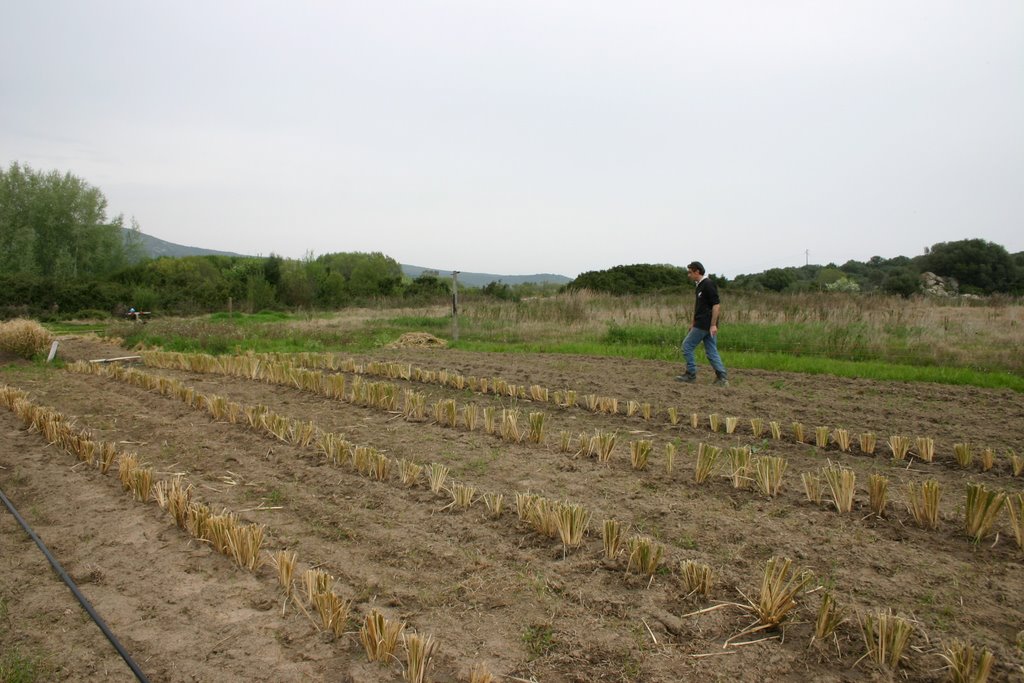
Us three, (the two mad ones and the Ferrari) set out to prepare a new nursery for a thousand new plants: five rows of more than 50 m each, spaced three meters.
We finish by the first of may, Titans stuff! Unfortunately Marta has to leave Sardynia and the new nursery at the beginning of July and goes back to Rome.


The new nursery, this time is irrigater with a very light dripping line which costs 18 cent of euro/meter and comes in large rolls of 3km.
Waterings are limited to only five in the intire summer period, and in the furrow, before planting, i put a slow release nitrogen fertilizer.This factor, of course, makes a great deal of difference and by september the hedges are fully established and is not easy to walk between them.

A great result. Grazie Martina